Write up and set up of Golu 100% hand crafted. No AI
Dashavatar – the 10 Avatars of Vishnu, the preserver.
To destroy that which does not sustain life, and thereby preserve life is the paradox that defines the Ten Avatars of Vishnu. Vishnu lies still in Vaikunta, in anantha-shayana or eternal sleep on Sesha, the serpant even as the waves ebb and flow around – Time and Maya constantly at play with one another. Silence within even when surrounded by noise. Inaction and action. Being and nothingness. Coexisting. Following a loosely evolutionary path, Vishnu is said to wake up from cosmic slumber whenever there is a threat to the steady state of matter. When evil threatens harmony, Vishnu is said to appear in a form that quells the uprising and restores equivalance and persistence in the world.

1. Matsya
It all started with a tiny little fish. A little fish that fit in one hand of King Satyavrata.
Beware, O’ king, the Fish said. Floods the likes of which you’ve never seen or heard is coming soon! Beware, O’ king, all life could be wiped out. No man, no woman nor any plant or an insect, not one breathing air or water may survive! Beware, O’ king, act now or forever life will be quietly unknown.
And so saying this, the fish grew. No matter where the king put it in, a golden bowl, a beautiful fountain, a placid pond, a bountiful lake, the fish outgrew them all.
Finally the King gathered seven sages, several humans, precious plants and necessary grains and two of every fauna and flora and all the collective human wisdom enshrined in the Vedas and set sail hauled by the mighty Matsya.
Thunder, lightning, rising tides and turbulent seas, the boat rocked on, its precious cargo precariously perched.
The demon Hayagriva saw his chance to steal the Vedas and amass the knowledge of sages as his own, but was no match for the mighty Matsya who quelled him with a blow.
And thus life and life’s knowledge were forever saved to propagate on.

2. Kurma
A story of a humble tortoise, a mighty mountain, the quest for eternity and an altruistic serpant.
Much like politics of the modern day, (make your own parallels).. the story goes that the Devas or divinely good beings once lost their powers in a moment of weakness and sought to regain it with Amrita or the elixir supreme churned from the cosmic ocean Kshira Sagara.
But alas having lost their powers, the Devas had to seek an alliance with their antagonists the Asuras or immoral beings. Seeing a golden opportunity the Asuras agreed to the deal for half the proceeds. Together they hatched a plan to churn the nectar laden ocean Kshira Sagara with the help of Vasuki the serpant and the mighty Mountain Meru. As they churned, the mountain trembled and wobbled, no match for the powerful currents of the mightier ocean. The Devas and Asuras had no recourse but to beseech Vishnu to save the day and he then took the avatar of Kurma, in the form of the ever dependable and humble tortoise.
Kurma held up Mount Meeru with quiet strength until nectar poured out. The chaos and power struggle that followed ..… well that’s a story for another day.

3. Varaha
Saved by the Boar!
Hiranyaksha, drunk on a concoction of pure evil, a generous dollop of narcissist delusions and topped off with his legendary strength once dragged earth down under the depths of ether and nothingness just to test his prowess.
Plants wilted, air breathers gasped – their every breath closer to their last, the aquatics whipped around in the churning seas, fins torn, thrown on land, total and complete chaos churning life like a little raft on turbulent seas. Depleted of air and of water earth spiraled to its demise much to the glee and villainous roar of the Asura.
That’s when up came Vishnu in the form of a boar, easing the earth onto his snout, framed by his horns, as Varaha, brought earth back from the depth of desolation to dharma and hope.
Varaha: when all seems lost, there’s always hope.


4. Narasimha
May I never die – the evil King Hiranyakashupu said to the Higher Power whom he had appeased.
But that’s not possible, said the Higher Power. Everything must go!
So be it, the Evil King said. Then let it be that I may not die in the morning or in the night, inside or outside, by man or by beast, on land or on sea.
“So let it be” said the Power that be, smiling stealthily. And that’s how it all came to be.
The king, he forgot he was a mortal. A demon drunk on his own ego, he went on a rampage killing the sages and looting the people. He built his coffers and starved his subjects.
The masses flocked to the Power that be, they begged and they pleaded, they wept and they prostrated, “You need to use your powers to help us,” they said. “
So be it the Power thundered. Aghast at the misuse of mortal power.
So the power that be descended on earth. Not as man or a beast. Not at night or day. Neither outside nor inside.
He came as Narasimha, Half human half beast, at dusk when it was neither day nor night, broke through a pillar, picking up Hiranyakasupi like an insect, sat at the entrance to his palace neither outside or inside, neither on land or at sea, but on his lap, to make a meal his entrails and so stopping the reign of evil at the brink of time.
Narasimha. Undefinable. Undefiable.
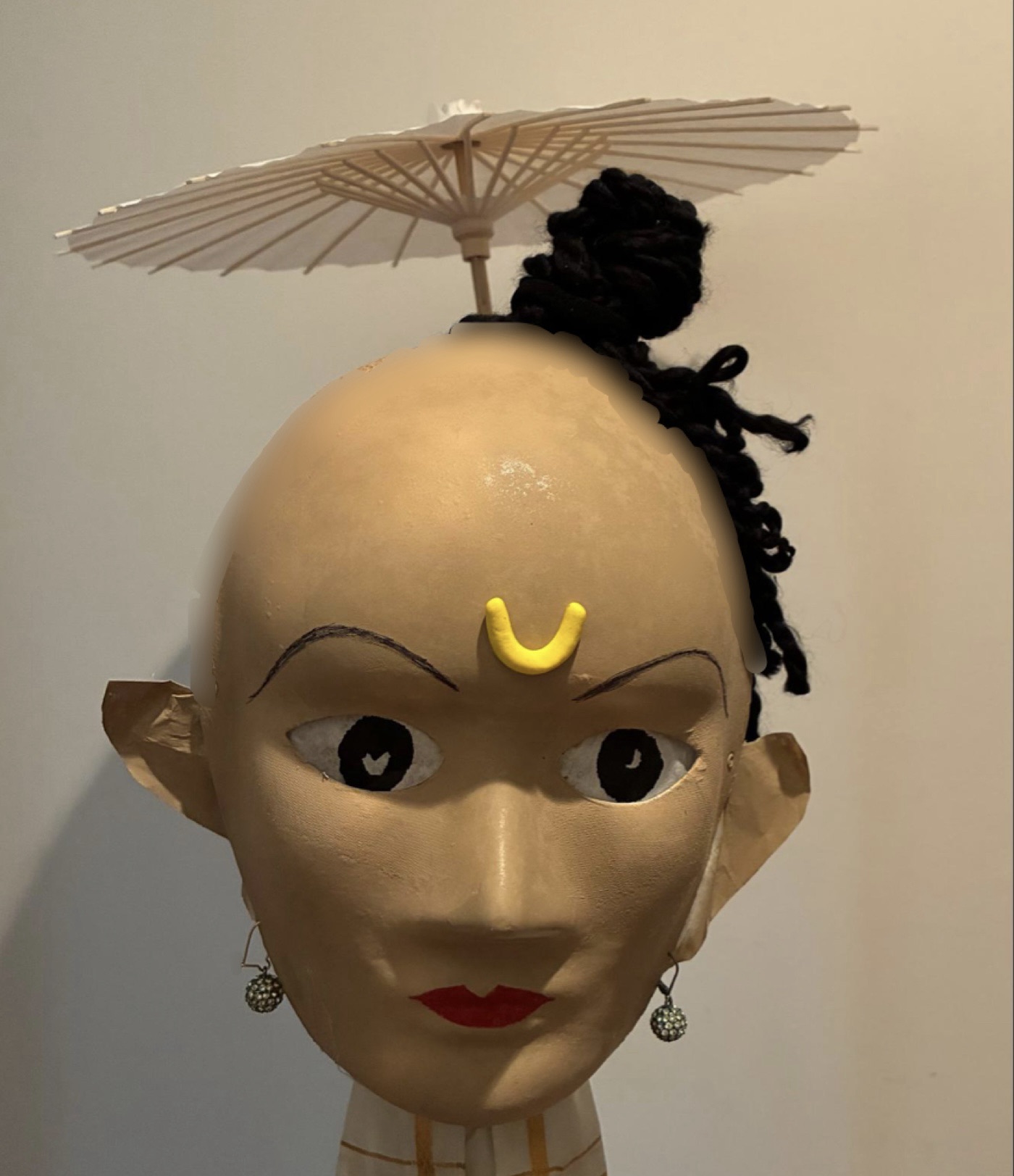
5. Vamana
Humility over Mighty.
It is said that the king Bali was generous to a fault. He could not refuse anyone’s request. It is said that he did a penance every year the last day of which beggars became choosers. Gold, silver, land or gems, you ask for it you got it. It is said that one day in a year, coffers were opened, deeds redone, the clang of coin showers resounded in the streets.
It is also said that the rest of the year his wrath knew no bounds. And the bulk of his actions remained unsaid, whispered behind locked doors, heard in the shivers of folks cowering in dark corners, in the buzzing of bees over dead bodies of those killed mercilessly, in the shrieks of torture of innocent souls.
You see he was a narcissist and could not bear to see anyone better than him.
It is said one year up came Vamana, to the festivities. Dressed in his little dhoti a sacred thread across his torso, his hair in a kudumi on his half shaven head. His only worldly possessions, a bamboo umbrella to save him from the UV, and his kamandalu or water jug to quench his thirst. He was completely missable in the milieu, all of three and a half feet tall that he was.
He waited until the end of festivities when people momentarily blinded by the king’s charming gaslights, their memories momentarily erased by the brilliance of gold and diamonds, were in tinsel coma.
And then the king noticed little Vamana. And asked “O’ little Brahmin, don’t you have any wish for me to fulfill”? Ask me anything you wish. Vamana replied – I’d like three bits of space as measured by my feet. The king looked at Vamana’s little feet, suppressed a guffaw and said sure take your three feet of space. And even as the king and all his subjects gasped, it is said, Vamana grew, his right foot covering all of earth, his left foot covering all of the skies and then he humbly asked King Bali, “Where can I put my third. O’King?”
Bali realized that the universe lay in this small figure, bowed down to him, his ego smashed, overcome with humility said “My head, O’lord. Use my head for the third foot of space”.
And so was an inflated ego quelled with humility. Humility that when provoked unravels its vishwaroopa or might of its entirety.

6. Parashurama
Anger. Raw and unbridled.
Anger. Merciless and just.
Anger. Seething and annihilating.
There are times when patience isn’t a virtue. When anger simmering over injustice rises up like a volcano spewing justice like lava, quelling opression with blistering heat. Charring the evil onto the dust.
Parashurama was anger personified.
Back when kshatriya (warrior class) kings banded together to become one undisputed, despotic whole, people became desperate, weighed down by taxes and tortures. Their say but of no avail, their entities existing only as much as in the service of royalty. Identities obliterated. Possessions possessed.
Then arose Parashurama, an axe his only weapon, that when struck with the momentum of his rage, could shatter worlds to smithereens and destroy masses of iron to plain air.
Legend has it when the villainous king Kartavira Arjuna killed his father, Parashurama rose to annihilate tyranny and restore cosmic order. A teacher of Bishma, Dronacharua and Karna of Mahabharata fame, he is tied to succeeding Avatars as well.
And most interestingly of all he is considered a Chiranjeevi – an immortal – a yogi who still lives amongst us and perhaps in us. Legend has it he will rise once again with Kalki to restore order and peace.

7. Rama
Rama = Perfection. The good son. A great king. From a spellbinding physique to unparalleled mastery of weaponry, from unwavering filial devotion to an ardent proponent of Dharma, Rama has been revered as the role model for mortals to emulate. An impossible standard indeed.
The defining story of Rama is of course the Ramayana. Sent into exile by a conniving step-mother Rama lives an idyllic life in the forest with his brother Lakshmana and wife Sita until Sita is abducted by the ten-headed King of Lanka, Ravana. How he rescues his wife Sita from the clutches of her abductor becomes the epic Ramayana.

8. Krishna
“If everything is Maya or Illusion, is our love Maya as well? Just an illusion”? Asked Radha. Krishna responded – “Our love is not Maya, dear Radhae. The belief there are two of us, now that’s Maya”.
Krishna. The god of love and valor. A Statesman unparalleled. A wizard. An infinitely multifaceted personality. A God almost human until he wasn’t.
Krishna had a way of melting hearts and melting with the crowd, the village playboy, a steadfast friend, a keen warrior, all the while destroying the vile from the demoness Putana to the Asura Kamsa and many more in between including Kalia the snake that threatened to devour the village. What did young Krishna do? He danced on its head instead!
A boyhood defined by the pure and intense love of his adopted mother, and his many romantic meanderings with the Gopis both have a profound philosophical depth beyond the platonic.
As an ally of the Pandavas in the famous Kurukshetra war, he finally showed the culmination of all his multitude of personalities as the Vishwaroopa, an entity spanning the cosmos as he shared life lessons with Arjuna in the form of Bhagavat Gita. The essence of which is basically do what you set out to do with a steadfast mind. Do not worry about the destination. Enjoy the journey.
Krishna is what life is all about. Morals and ethos are not black and white but grey, and can still fall under Dharma the righteous way.

9. Buddha
Buddham Charanam Gachchaami.
Sangam Charanam Gachchaami
Dharmam Charanam Gachchaami.
Gautama Buddha. The enlightened one. One born as Siddhartha, a prince insulated from the world, he set out to actively seek suffering.
Tormented by life’s most existential questions, Siddhartha renounced royalty and spent years in search of truth. Truth that dawned on him under a Bodhi tree. Truth that set him free and truth that he shared with the world as the eightfold middle path.
Gautama Buddha did not quell any demons or Asuras as the avatars preceding him. This perhaps symbolizes the transition into modern civilization and the demons that are within.

10. Kalki
The here and now. Today.
The race is on. AI . Global warming, carbon footprint, ozone depletion… The race is on – to save the earth. There is panic everywhere. Almost as much panic as plastic in a landfill, choking us, as we bleakly look everywhere for a solution. For a miracle cure, a global reset that would assure us…that no, the earth will NOT change, that we will survive as a species forever, and that all will be well.
Kalki. Our hopes lie with the generations X, Y and beyond. That they will take the physical to metaphysical. That a new day will dawn. The old ways .. they have long expired. Corporate greed. Mind numbing 9-5’s. Greed. Self obsession of the insta kind. Death of creativity. Perhaps the new dawn will once again birth the creator in each one of us. The world awaits Kalki. The modern day futuristic avatar.